Buyer's guide · Updated October 2026
Best bandsaw blades for cutting metal in Australia
The best bandsaw blades for mild steel, structural sections, stainless and hard alloys: which blade to buy, what makes a blade last, and how to pick the right tooth pitch.
Written by the team at Superior Saws, an authorised Amada distributor welding bandsaw blades in Sydney and Brisbane since 1982.
The short answer: the best bandsaw blades for metal
For most Australian workshops cutting steel, the best choice is a cobalt (M42) bimetal bandsaw blade matched to what you cut, with the right tooth pitch, welded properly to your saw's length. Our pick for metal cutting is Amada: blades designed by a bandsaw machine maker and built for production cutting.
- General steel, tube and solids: Amada SGLB, the M42 all-rounder, or Amada Cobalt 8 for everyday mild steel.
- Structural beams, channel and bundles: Amada Protector II, built to resist tooth chipping.
- Stainless, tool steel and hard alloys: Amada Magnum or Magnum Hi-Low, or Amada Axcela G coated carbide for production cutting.
- Thin-wall tube and light sections: Amada Duos, a fine-pitch blade.
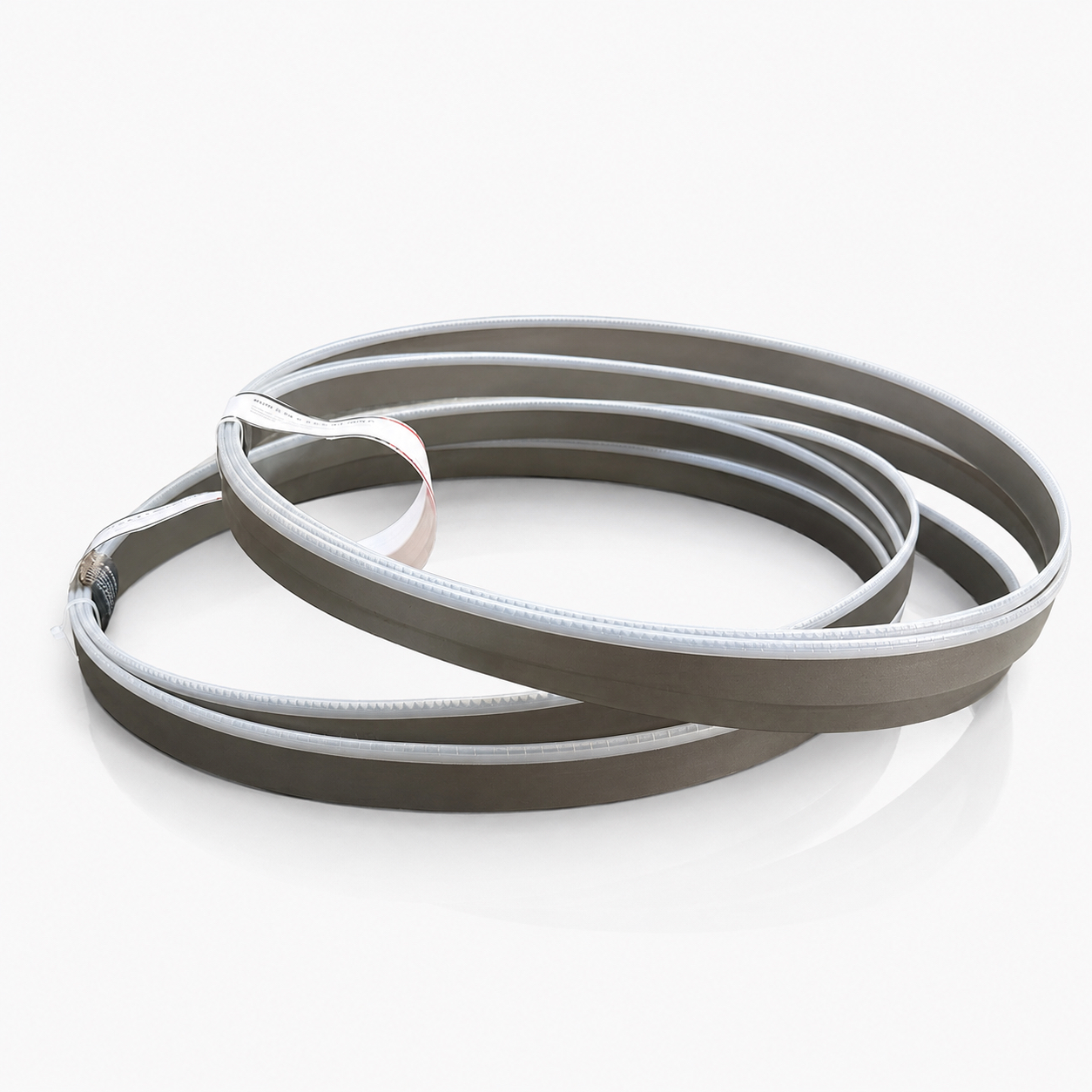
What makes a good metal-cutting bandsaw blade?
- M42 cobalt teeth. High-speed-steel teeth with about 8% cobalt stay hard at cutting heat, so they cut faster and last far longer than carbon blades in steel.
- Tooth geometry matched to the job. Rake angle, set and variable pitch decide whether a blade cuts straight, stays quiet and resists chipping in interrupted cuts.
- A tough, fatigue-resistant back. The spring-steel backing takes thousands of flex cycles around the wheels. A better back means fewer cracks and breakages.
- A properly made weld. Most blades fail at the weld. A clean, annealed and dressed weld is just as important as the blade itself.
Overall, Amada ticks every box. As a bandsaw machine manufacturer, Amada designs its blades around how production saws actually cut, and every Amada blade we sell is welded in our own workshops.
Amada vs other bandsaw blade brands
You'll see Lenox, Bahco, Starrett and Excision bandsaw blades sold in Australia too. Here's how Amada compares, and why it's the brand we chose to stock and weld.
| Brand | Made / based | Metal-cutting range |
|---|---|---|
| Amada | Japan (welded in Australia) | SGLB, Cobalt 8, Magnum, Magnum Hi-Low, Protector II, Duos, Axcela G carbide |
| Lenox | USA | Classic, Contestor GT, Diemaster 2 |
| Bahco | Sweden | Sandflex range |
| Starrett | USA / Brazil | Intenss and Versatix ranges |
| Excision | Australia (German material) | Bi-Alfa range: M42 and M51 cobalt bimetal (including Profile), plus carbide blades |
Why we choose Amada
- Made by a bandsaw machine manufacturer. Amada builds production bandsaws as well as blades, so its blades are engineered for the feeds, speeds and tension real saws run at.
- A blade for every job. For example, from the SGLB all-rounder to Protector II for structurals, Magnum for stainless and Axcela G carbide for hard alloys, there's an Amada blade designed for each material.
- Genuine stock, welded locally. As an authorised Amada distributor we hold genuine Amada coil and weld every blade in-house in Sydney and Brisbane.
- Backed by people who cut metal. We've supplied Australian workshops since 1982 and can help you match the right blade and pitch to your saw.
Lenox, Bahco, Starrett and Excision are trademarks of their respective owners. Superior Saws is not affiliated with these brands. Brand and range details are taken from publicly available information and may change; check each maker for current specifications.
Our picks: the best Amada bandsaw blades for each job
Amada builds bandsaw machines as well as blades, so its blades are designed around how production saws actually cut: feed rates, blade tension and chip load. As a result, in our workshops that shows up as straighter cuts and longer blade life in the materials that wear out cheaper blades fastest.
Amada SGLB: the all-rounder
Our first choice for mixed workshops. One SGLB blade handles mild steel, tube, solids and moderately hard materials, so you don't need to change blades between jobs. View SGLB blades
Amada Cobalt 8: everyday mild steel
Cobalt 8 is also good value for general fabrication and structural steel. View Cobalt 8 blades
Amada Protector II: beams, channel and bundles
Its tooth design resists chipping from interrupted cuts. Therefore, it is the blade to use on structural sections and bundle cutting. View Protector II blades
Amada Magnum and Magnum Hi-Low: stainless and tough steels
Heavy-duty bimetal for stainless, die steel and large solids. In addition, the Hi-Low tooth set suits vibration-prone and larger cuts. Magnum · Magnum Hi-Low
Amada Axcela G: coated carbide for production
For high-volume cutting, hard alloys, nickel and titanium. On the right saw, it also cuts much faster and lasts far longer than bimetal. View Axcela G
Amada Duos: thin-wall tube
Fine-pitch blade for thin-walled tube and light structurals where coarse teeth strip or snag. View Duos blades
The best bandsaw blades for each material
| Material | Blade type | Amada blade |
|---|---|---|
| Mild steel solids | M42 bimetal | SGLB or Cobalt 8 |
| RHS, SHS and round tube | M42 bimetal, finer pitch | SGLB, or Duos for thin wall |
| Beams, channel, angle, bundles | Chip-resistant bimetal | Protector II |
| Stainless steel (304, 316) | Heavy-duty bimetal or carbide | Magnum, Magnum Hi-Low, Axcela G |
| Tool and die steel | Heavy-duty bimetal or carbide | Magnum, Axcela G |
| Nickel alloys and titanium | Coated carbide | Axcela G |
| Aluminium and non-ferrous | Coarse-pitch bimetal | SGLB (coarse pitch) |
Get the best from your bandsaw blades: tooth pitch (TPI)
The rule of thumb is to keep 3 to 6 teeth in the cut at all times. If there are too few teeth, they chip or strip. On the other hand, too many teeth clog the gullets, so the blade wanders and wears out early.
| Solid bar diameter | Suggested pitch | Tube / section wall | Suggested pitch |
|---|---|---|---|
| Up to 30 mm | 6/10 TPI | Up to 2 mm | 10/14 TPI |
| 30–60 mm | 5/8 or 4/6 TPI | 2–4 mm | 8/12 or 6/10 TPI |
| 60–120 mm | 3/4 TPI | 4–8 mm | 5/8 TPI |
| 120–250 mm | 2/3 TPI | 8–12 mm | 4/6 TPI |
| 250 mm and over | 1.4/2 or 1/1.5 TPI | Over 12 mm | 3/4 TPI |
Still not sure? In that case, our Blade Finder recommends the blade and pitch for your material and size, and shows what we have in stock.
Why the weld matters as much as the brand
In fact, most bandsaw blades fail at the weld, not the teeth. As a result, a great blade with a poor weld breaks early. At Superior Saws we weld every Amada blade in-house at Smithfield NSW and Northgate QLD, then anneal and dress the joint so it runs smoothly through your guides. Moreover, we weld to any length for Amada, Behringer, Kasto, Everising, Hafco and other bandsaws.
Need a blade for your saw?
Tell us your machine and what you cut, and we'll match the right Amada blade and pitch, welded to length and delivered Australia-wide.
Shop bandsaw blades Use the Blade Finder Call (02) 8787 6900Best bandsaw blades: FAQs
What is the best bandsaw blade for cutting metal?
For most workshops, an M42 cobalt bimetal blade such as Amada SGLB is the best all-round choice for steel. For structural sections use Amada Protector II, and for stainless or hard alloys use Amada Magnum or Axcela G carbide. Pick the tooth pitch to suit the size of what you cut.
How does Amada compare to Lenox, Bahco, Starrett and Excision?
Lenox, Bahco, Starrett and Excision all sell M42 bimetal bandsaw blades in Australia. We chose to stock Amada because Amada also manufactures bandsaw machines and offers a dedicated blade for each material, from SGLB for general steel to Magnum for stainless and Axcela G carbide for hard alloys. As an authorised Amada distributor we weld genuine Amada blades to length in Sydney and Brisbane, and we can help you choose the right blade and pitch for your saw.
Are cobalt (M42) bandsaw blades worth it?
Yes, for metal cutting. M42 teeth contain about 8% cobalt, which keeps them hard at cutting heat. A cobalt bimetal blade typically cuts faster and lasts several times longer than a carbon blade in steel.
What bandsaw blade should I use for stainless steel?
Use a heavy-duty bimetal such as Amada Magnum or Magnum Hi-Low, or coated carbide such as Amada Axcela G for production work. In addition, run slower speeds than for mild steel, use plenty of coolant and keep the feed steady so the blade doesn't work-harden the cut.
How long should a bandsaw blade last?
Above all, it depends on material, blade speed, feed and coolant. Correct run-in (breaking in a new blade at reduced feed for the first cuts), the right tooth pitch and good coolant make the biggest difference to blade life.
Can you weld a bandsaw blade to my saw's length?
Yes. We weld Amada blades to any length in Sydney and Brisbane. First, send us the length, width, thickness and pitch, or your machine make and model, and we'll make it up.